90min Songwriting Challenge 23/12/2011
Tonight we had our first ever songwriting challenge. Two teams of music hackers who’ve never worked together before. 90 mins to write a song….
Here’s what happened!
90 Min Challenge 23/12/2011 by musichackspace
Team 1: Billy, Gal, Tom, DoorBot > Bikes&machines.mp3 <–download
Tom went on to finish the track. Here it is after 4 hours worth of editing, sampling and mixing > Bikes&Stuff-Final.mp3 <–download


Team 2: Andrew, Giom, Zambari, Ziad > hackspacecut.mp3 <–download


Marek Bereza: 5 audio projects
Marek started doing audio in his teens. At 14, he wanted to use pedals and started making his own ones!


Then he wanted a guitar, so what did he do? He made one…
His interests moved to software later on and he designed SampleToy, an audio freeze tool for the iPhone and the iPad.
Michael Page: hardware step sequencer and machines
Michael brought an impressive collection of home made hardware machines built to make sounds.
Michael Page


The Victorian Synthesizer


The circuit bent Bontempi toy synthesizer


bent toy synth

Bent toy analog drum machine

Bent Karaoke machine with added Spring reverb

The mechanical step sequencer


The set-up


The step sequencer
The drum machine and the Karaoke machine
All sorts of little gadgets

I wanted to blog as the workshop went, but instead I made a few videos.
In hte following video, Michael explains how his step sequencer works.
In this video, Michael explains how he hacked a bontempi keyboard and links it to a solenoid reverb machine.
Enrico Bertelli
Enrico Bertelli
PhD candidate in Contemporary Performance – Percussion and Electronics. Website.
Deeply interested in alternative performance solutions, focussed on the theatricality of the percussive gesture. The regular performances in various European festivals showcase an interest in creating a strong connection with the audience. The speech is consistently present between pieces and is also incorporated directly into the more theatrical one. The public is led seamlessly into the performance, unable to distinguish the boundaries with the presentation or to identify the gestures.

Presentation
An investigation of MIDI and live-electronics applied to percussion, in a creative way. The research aims to overcome the spacial and logistic problems that every percussionist has to face day after day: noisy, small and cluttered rooms.
Samplers and various ad hoc patches have been used to collect an original library and to transform aseptic MIDI instruments into responsive and organic one-man-band instruments.
The electro-acoustic side of the research looks into how to generate longer and, most of all, pitched sounds, from the short outbursts of a snare drum. New sticks, new techniques, new approaches.

Inspirational Audio Projects
Creative Applications is one of the few blogs that I follow. Showing a wide range of interesting experiments and installations. A fair few of them happen to be sound related. With courtesy to Creative Applications I have selected a few of the more recent audio related posts that I liked best. Hope it will bring some inspiration.
A hand held poem Generator
dadaBox – making dadaism tangible from jifei ou on Vimeo.
The video below, created by Lasal, shows a short part of a new installation which explores the relationship between 2 Harmonic waves in different graphical/musical ways. The piece includes 98 pair of points trigger notes depending on the collision position in the Y axis and panning depends on the X position. The phase and velocity of booth waves are synchronised to collide in a harmonic chord.
Harmophon from lasal on Vimeo.
Designed by Katharina Hölzl, the following are very special business cards for Ritornell
Ritornell for Musicbox from Ritornell on Vimeo.
Chop up your vinyl records and assemble them into new ones.
Analog Vinyl Sampling from Ishac Bertran on Vimeo.
Created by Émile Sacré, Kulbuto is an installation and an instrument, exploring possibilities of non-uniform compositions by both visualising what is being created and using the visual content as the driving force behind the rhythmic cycles.
KULBUTO — Audiovisual music instrument from Émile Sacré / vect on Vimeo.
Also make sure to investigate the google chrome audio experiments
Music Hack Day report
A few of us attended Music Hack Day, held at the Barbican this week end. Martin had taken some gear and soldering irons from the space that were put to good use by the people there. A list of all the hacks presented on Sunday is available here.

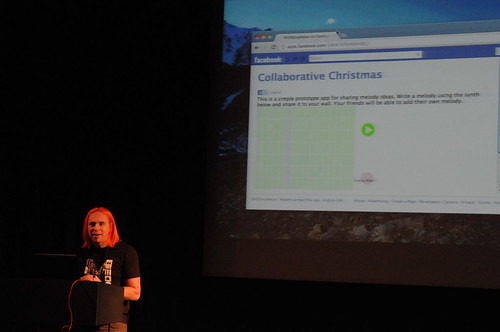
Among the hacks presented, the Music Hackspace was represented by Alex Shaw and Anthony Bowyer Lowe. Alex, with distinctive bright orange hair, presented a collaborative step sequencer that runs on Facebook, presented under the catchy name of Every year I ask for a Nintendo, and every year they give me socks and another bloody step sequencer.
Anthony presented the hack Techno is the Word! which takes a word to generate techno and a series of fun statistics, such as their scrabble score and others. Anthony managed to do an online demo that works with Chrome. Check it out.

Our new friend @rainycat made a wearable instrument, which was the only hardware hack of the session. She deserved a special prize for that and I hope that the next edition of Music Hack Day will feature an award for hardware hacks. Here is her website: http://rainycatz.wordpress.com/

Finally, a special mention to Roderick Hodgson for his helicopter toy turned into a theremin, which captured the audience attention. He called the hack the Helimin.
Photos credits to Thomas Bonte
Introduction to Pure Data by Andy Farnell
Pure Data is a visual environment for programming sound. Andy uses it for sound design and for teaching purposes. He finds it a very useful tool to teach secondary school students and PhD students. It allows to mock up ideas very quickly, faster than by using programming languages such as C++.
Andy is the author of the excellent book Designing Sound, available from MIT Press and other online distributors. It’s a great way to get into Pure Data and programmatic sound design. More about Andy on his website.

Andy Farnell at the Hackspace
It is also easier to access and understand. In the patch below, the ‘noise~’ object generates white noise (the sound of your aerial TV when there’s no channel available). This white noise is sent to an amplifier, the ‘*~’ object. This object allows to control the volume of the sound using the number box above it. The white noise is then sent to the speakers via an Digital Analog Converter (the ‘dac~’ object). It’s that simple.

A PD patch to make noise
It’s also easy, if you want to use a MIDI controller, to allow MIDI notes in your patch. In the patch below, we use the object ‘notin’ which allows MIDI messages to be connected to something.The notes are converted to frequency with the object ‘mtof’ (Midi TO Frequency). The value is then sent to a ‘phasor~’ object which generates a sawtooth signal, then sent to the dac.

A basic synthesizer in PD
Ariel was using his computer to learn PD during the session and we connected his computer to Anduy’s computer using OSC through the wifi network. There was a wooow moment when a ‘bang’ was sent from Andy’s computer and showed up in Ariel’s console. Now they’re working on making a sampler over the network!
This is the result of it. Ariel controls the volume of the sample from his computer.

Collaborative PD patch controlled by a remote computer
To Ziad’s request, Andy gave us an introduction to sequencing. In the patch below, the ‘metro’ sends a ‘bang’ which is delayed at 4 different time values to create a pattern.

An improvised four-step sequencer
Mick Grierson: Maximilian and OpenFrameworks
Thursday 24/11/2011

Mick Grierson setting up
Maximilian is an open source C++ toolkit for audio dsp.
https://github.com/micknoise/Maximilian
http://maximilian.strangeloop.co.uk
Maximilian is an open source, MIT licensed C++ audio synthesis library. It’s designed to be cross platform and simple to use. The syntax and program structure are based on the popular ‘Processing’ environment. Maximilian provides standard waveforms, envelopes, sample playback, resonant filters, and delay lines. In addition, equal power stereo, quadraphonic and 8-channel ambisonic support is included. There’s also Granular synthesisers with Timestretching, FFTs and some Music Information Retrieval stuff.
There’s a command line version, and an openFrameworks addon called ofxMaxim. It also works well with Cinder, or just about anything else.
Electronic music legends are back

I’m sure that many of you are just like me. “If I only had [insert piece of gear of your dreams] My music would be so much better”. The grass is always greener on the other side. When I first started tinkering with electronic music in my teens me and a few friends had access to small MIDI studio at a youth centre run by the council. You had to book in to use it. We had an Ensoniq EPS 16+ Sampler, a Roland Juno 106 and some crappy sound canvas thing. None of us had a portable CD player and we where to dumb to realise that we could squeeze a fair bit of interesting sounds out of the Juno 106 for sampling purposes. What we did was to record sound samples onto cassette of my Amiga home computer, and then sample them resulting in super low fi sounds. We hated it, we where dreaming of clean sounds without noise and the possibility to record the result on to DAT.
Today it’s the other way around, using only software easily results in something to polished and to clean in my opinion. The grass is often greener yes, and to strike the right balance is tricky.
I assume this goes with gear swell, “If I only had…” will always apply, and is probably the biggest reason why I haven’t started doing modular synths.
For you who like me suffers from this from time to time, listening to electronic music giants Martin Gore and Vince Clarks latest collaboration is to me proof of that your gear will not make your music. It’s a shame how it all turned out.
Listen to the first released clip and read more here http://thequietus.com/articles/07500-vcmg-vince-clarke-martin-l-gore-spock
Vince clarks setup is just to die for, I would love to get the chance to use his studio for a while
Vince has done a terrific short series on Youtube called The Vince Clarke Analogue Monologues about one of his gear
http://www.youtube.com/watch?v=Rwa0hssjboA&feature=related
Martin Klang and Adrian Gierakowsky
Thursday 17/11/2011
Martin presented Taquito, an electronic wind instrument. Adrian presented a piece of software, which he has been developing since May 2010 and a multitouch iPad controller, which was especially designed to facilitate the use of this software in live performance.
Martin and Adrian performed together at the end of the presentation.

Martin and Adrian presenting
Project description
The ag.granur.suite is a modular system for sound design, composition and live performance, build around a granular synthesis engine, which enables its user to explore rhythm, timbre, melody, harmony and texture on a continuos timescale and seamlessly transition between them. Additionally, the multichannel capabilities of the software (grains can be scattered between up to 64 discrete channels) facilitate exploration of the relationships between the above musical elements and physical space. An early version of the software has already been used in live performance during concerts in London and Aldeburgh.
The iPad controller features an innovative user interface, which makes full use of the multitouch capabilities of the device, and facilitates expressive and intuitive control over the software during live performance. Due to the fact that visual feedback is displayed directly on the device, the performer doesn’t have to look at the computer screen at all, and can direct all his attention to the performance.
Adrian Gierakowski Bio
Adrian is classically trained pianist of Polish origin, a composer of instrumental, electroacoustic and electronic music and a self taught programmer. He received a degree in Creative Music Technology from the University of Huddersfield with a special award for creative programming. His work have beed performed in London (Kings Place), Aldeburgh (Snape Maltings, Britten Studio), Champaign (IL, USA), Huddersfield and York. Currently he is studying for a Masters by research degree at the University of Huddersfield. His research is focused on the use of multitouch-screen interfaces for live performance of electronic music.
Resources
software website with description and download links: http://audibledata.com/Software.html
demo of ag.granular.suite: http://vimeo.com/19108649
multitouch controller: http://vimeo.com/27190010
performance in London: http://vimeo.com/19323406