Rebel Technology: Open Source Synth Modules

We’re on the cusp of officially launching the Rebel Technology website. Sneak previews available now!
The first module we’re publishing is the Euclidean Sequencer, which some of you have seen and heard already – we brought a couple along for the Synthesiser Day at Rough Trade East, and prototypes have been racked up in the Hackstudio.
Audiovisual synthesisers: Tasos Stamou
Thursday 17th of May 2012, 7pm. Tasos Stamou will present his work on audiovisual synthesisers.
Tasos Stamou, an electroacoustic composer, free improviser and instrument maker will present some of his latest designs. The devices -100% recycled in materials and sounds- combine circuit bent toy-instruments with analogue modular synthesizer utilities and audiovisual synchronizations.
The text below is from Tasos’s website: http://tasosstamou.com/projects.html

VHSynth is an audiovisual project that incorporates analog video signals and handmade synthesizers. It is a result of a fully recycled found-in-trash vintage VHS equipment that has been modified so as to become part of a DIY modular synthesizer setup suitable for live performance and improvisation. Video tapes provide video/audio signal, cassette cases enclosure DIY and bent circuits and a handheld video editor was hacked so as to react as a video synthesizer synching with sound. Taking advantage of the medium’s imperfections (hiss, signal errors and damaged tape) the resulting aesthetics of the project tributes to the low budget cult video productions and home movies of the past decades.


Views from the usual “VHSynth” setup and devices and a detail of the modified handheld video editor from “datavideo”.
Extracts from live performance with the “VHSynth”. No post effects processing applied, just raw A/V signal capture.
<>
Synthesizer Day
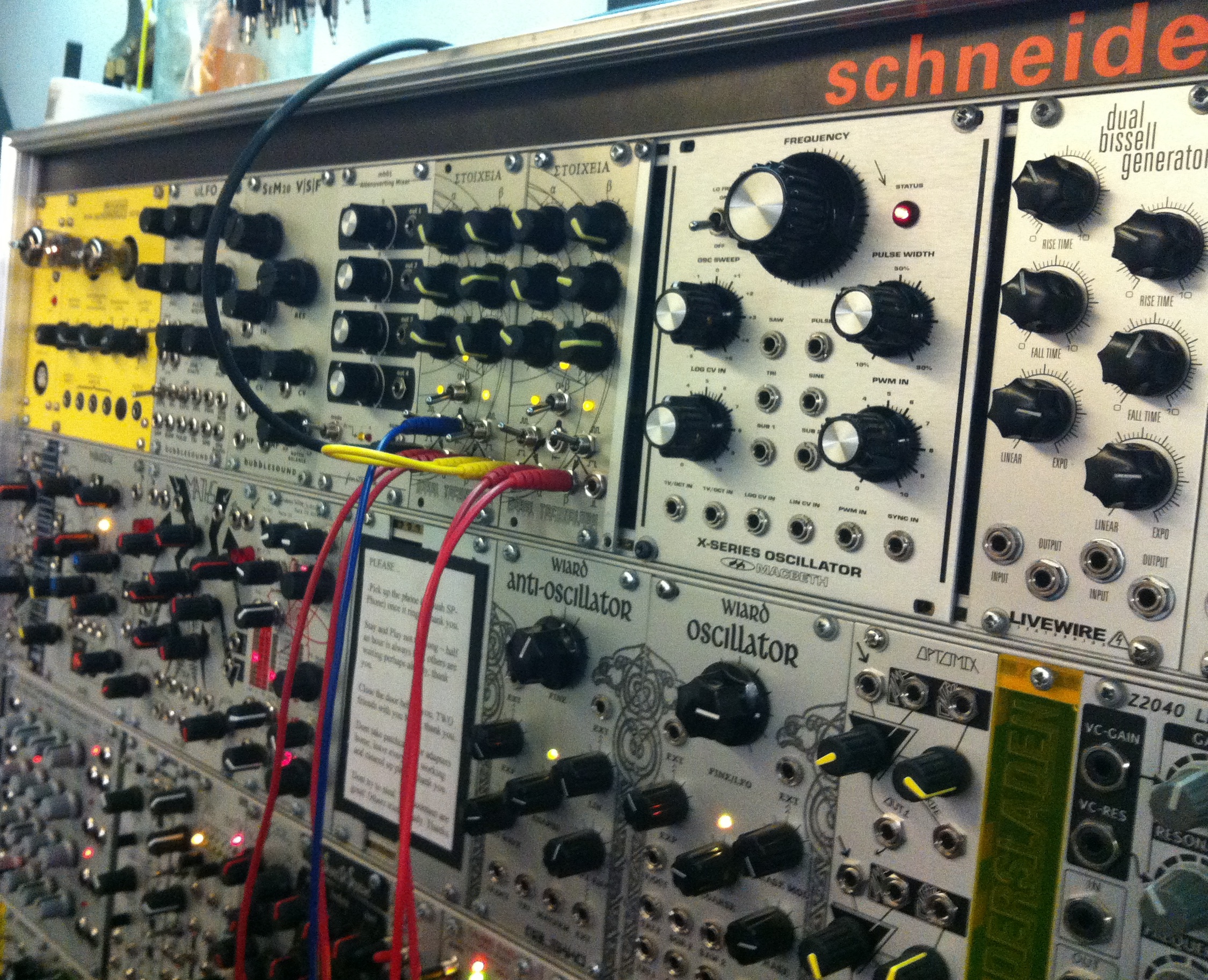 Big thanks to everyone who came to talk to us yesterday, and big ups to Andreas Schneider for organising the event!
We had a great time, and got to talk to other makers such as vxxy and AlphaSphere. We also had lots of positive feedback from people coming to use the modulars – fair to say that our Euclidean Sequencers were kicking it off!
More news and photos coming soon.
Rebel Technology at Rough Trade
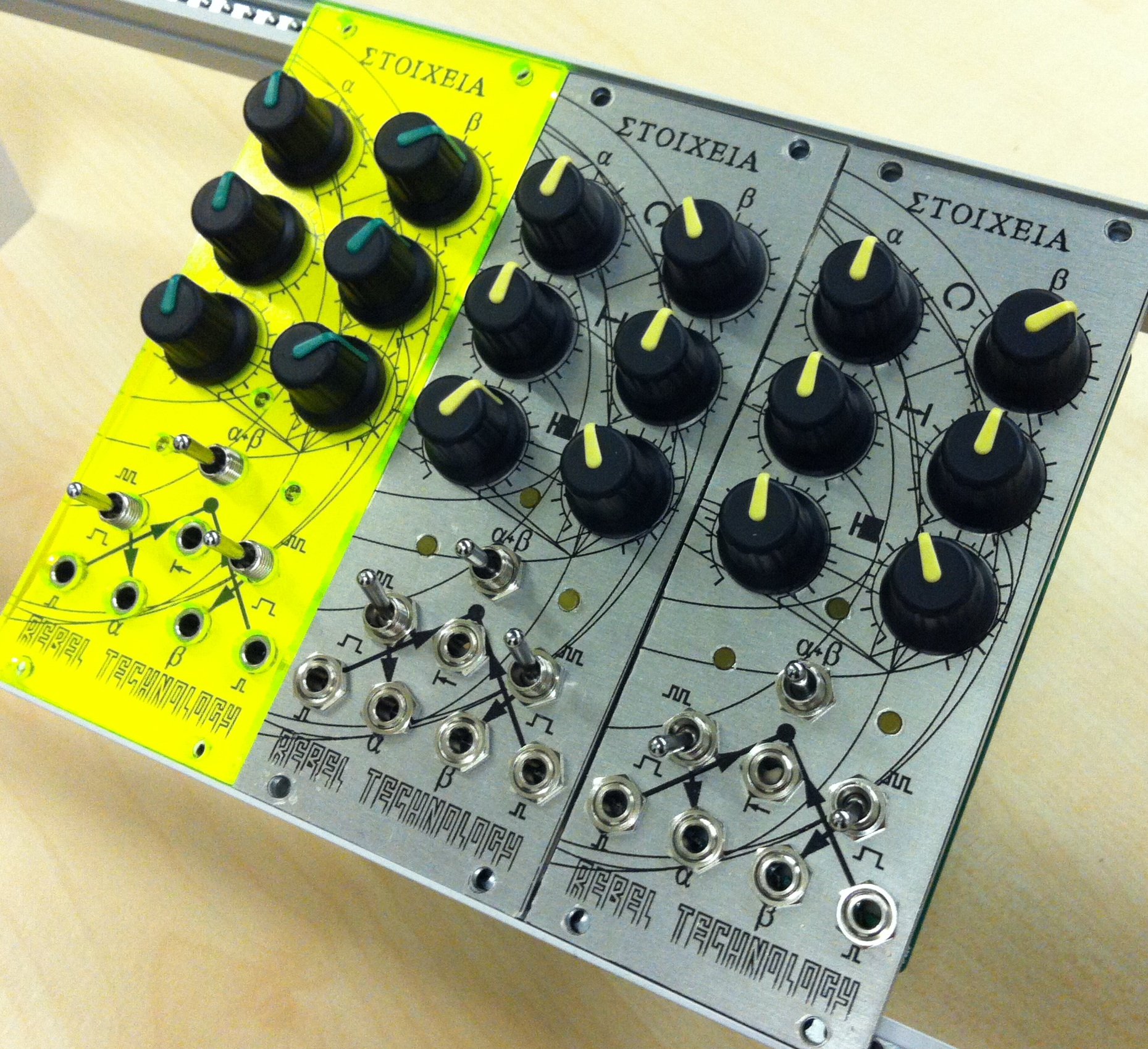
Rebel Technology will be at Rough Trade East on May 2nd, showing the new Stoicheia module. We’re taking part in their Synthesizer Day organised with Schneiders Buero.
 Our modules will be set up in Schneider’s TestSalon, and you will be able to play with them to your heart’s content. See you there!
Howling Monkey: Curating in the Music Space
Thursday 3rd of May 2012, 7pm.
Ben Bleet will present the activities of Howling Monkey: creating and curating in the music space.

Ben will discuss the innovation opportunities in the areas of digital, live and experience of the Music Industry.
Chapeau to Music Hack Paris
What happens to a charming Parisian factory when it stops making cardboard? It hosts a Hackathon! They called it Music Hack Paris.
Although cardboard was not involved, laptops weren’t the only tools to be seen. The hackers made sonic sculptures, jammed with old and new musical instruments, and played table football. There being around 100 hackers involved, by the end of the event you pretty much had had a chance to chat with most people. It felt cosy, and the factory’s authentic 19th century furniture and workrooms gave the event a magical atmosphere that many hackathon held in concrete blocks tend to lack.

Building a musical sculpture
The projects people worked on included a healthy amount of web apps, among them some very impressive music visualisers, and an app that could get a song to be played in perfect sync on three different computers, with the user being able to control each computer’s EQ. There were also physical interfaces presented, among them was the Dualo, a fingerboard interface offering clever music theory shortcuts, a musical carpet, and a mouth-controlled wah-wah pedal (now it’s no longer an onomatopoeia). I had the chance to accompany the latter with beatbox during a couple of jams and performances, and also participated in a collaborative loop-making web app. Many people brought instruments to the event, and beautiful jams began sprouting.

One of the jams
Chapeau (hats off to) the organisers: the Google Cultural Institute, JoshFire, the UNESCO, and the Cartonnerie staff. They got so many things right. Splendid venue, great selection of speakers for the lightning talks (including yours truly on behalf of the London Music Hackspace), table football, solid wifi, comfy couches, and what was probably the finest food ever served at a Hack event: croissants, scrambled eggs, pancakes, ah, we felt loved. They even kicked off the demos with a video message of Herbie Hancock himself, giving us his blessing for making creative tools for musicians.

Busy hacking tables at the Cartonnerie
Herbie, our pleasure.
Check out the latest pictures, sounds and videos of the event on the event’s home page:
http://www.musichackparis.org/
SOLARIS: visual vinyls
Thursday 26th of April 2012.
The SOLARIS project uses painted discs to create music and is led by French artist Thierry Guibert. Thierry crafts beautiful graphics on vinyls. These vinyls are used on a special set of turntables, where the diamond stylus is replaced by a camera to capture images as the disc spins mechanically. The aim of the presentation is to workshop strategies for using visuals to control music events. A few musical examples will be presented.The goal of this project is to create musical content for each disc, allowing to perform with a revisited DJ set, and adding to the performance beautiful and meaningful visuals.

Jean-Baptiste Thiebaut works with Thierry on this project, to analyse the images captured by the camera and to produce musical results. The visuals are analysed with the OpenCV library of OpenFrameworks, and the data is shared among applications using OSC.

The video below shows how the image flow is analysed in ‘blobs’ (using contour detection). These blobs may have different sizes, which is shown on the right side of the video. For each blob, an average colour is calculated. At every frame of the video correspond a number of blobs, which can be used to create sounds.
Record and Ride

Last week, we received a visit by Nicholas O’Brien, a sound engineer embarking on a cycling journey in Europe to record artists along the way. We hope to see Nicholas when he’s back to the UK and wish him a great experience! You can follow his adventures on his blog: http://record-and-ride.com/
We will be following his journey and reporting when we can the interesting musicians he will encounter.
Below is a video of the man himself and a few recordings he made in London.
Introduction to SuperCollider
SuperCollider is an interpreted music environment developed by James McCartney in 1996. It was open-sourced in 2002 when McCartney joined Apple. Since then, SuperCollider has been adopted by a growing community of musicians-developers.

In April 2012, Queen Mary University joined forces with Goldsmiths and City Universities to organise a London symposium. The event featured artistic installations, seminars, talks, concerts and even a dubstep remix competition, with a coverage from the BBC.
Shelly Knotts and Les Hutchins gave us an overview of their work with SuperCollider. They share musical data through the network and perform with the Birmingham Laptop Ensemble (BiLE). This is one of the very interesting advantage of SuperCollider, its client/server architecture facilitates collaboration and remote jamming. Musicians send each other data and create music locally instead of sending audio signal to the network. SuperCollider is so lightweight that Dan Stowell et al. made an album using 140-characters Tweets in form of SuperCollider instructions (sc140)!

A very interesting night indeed, with pizza and Martin’s warm Stout.
Here is what a SuperCollider environment looks like:

“A Hackday” by Pauline de Zeeuw
Pauline filmed this short documentary at the last Music Hackday in London, December 2011.This documentary reflects well the atmosphere of Music Hackdays as well as that of the Hackspace. Well done to her!
A Hackday from Pauline de Zeeuw on Vimeo.