Music Hackspace at BEAM Festival
The Music Hackspace is going to BEAM!
We will be there from Friday 22nd to Sunday 24th of June 2012. We will show the SOLARIS project (Jean-Baptiste Thiébaut and Thierry Guibert), Michael Page’s mechanical step sequencer, Martin Klang’s Euclidian Sequencer, Ariel Elkin’s AriVibes, Tasos Stamou’s bended toys, Jag’s din is noise, and more…
On Sunday, we perform together as the Hackspace Big Band. Exciting stuff.

Stoicheia Video
Here’s a user video of our Euclidean Sequencer –
Jim Credland rockin’ out with one of the very first prototypes!
Euclidean Sequencer Published
 Our first module Stoicheia, the Euclidean Sequencer, is now available.
We are publishing the source code, which you can access via github, as well as the hardware design.
We hope that this will encourage tinkering, bending, extensions and improvements – for all to hack to your hearts’ delight!
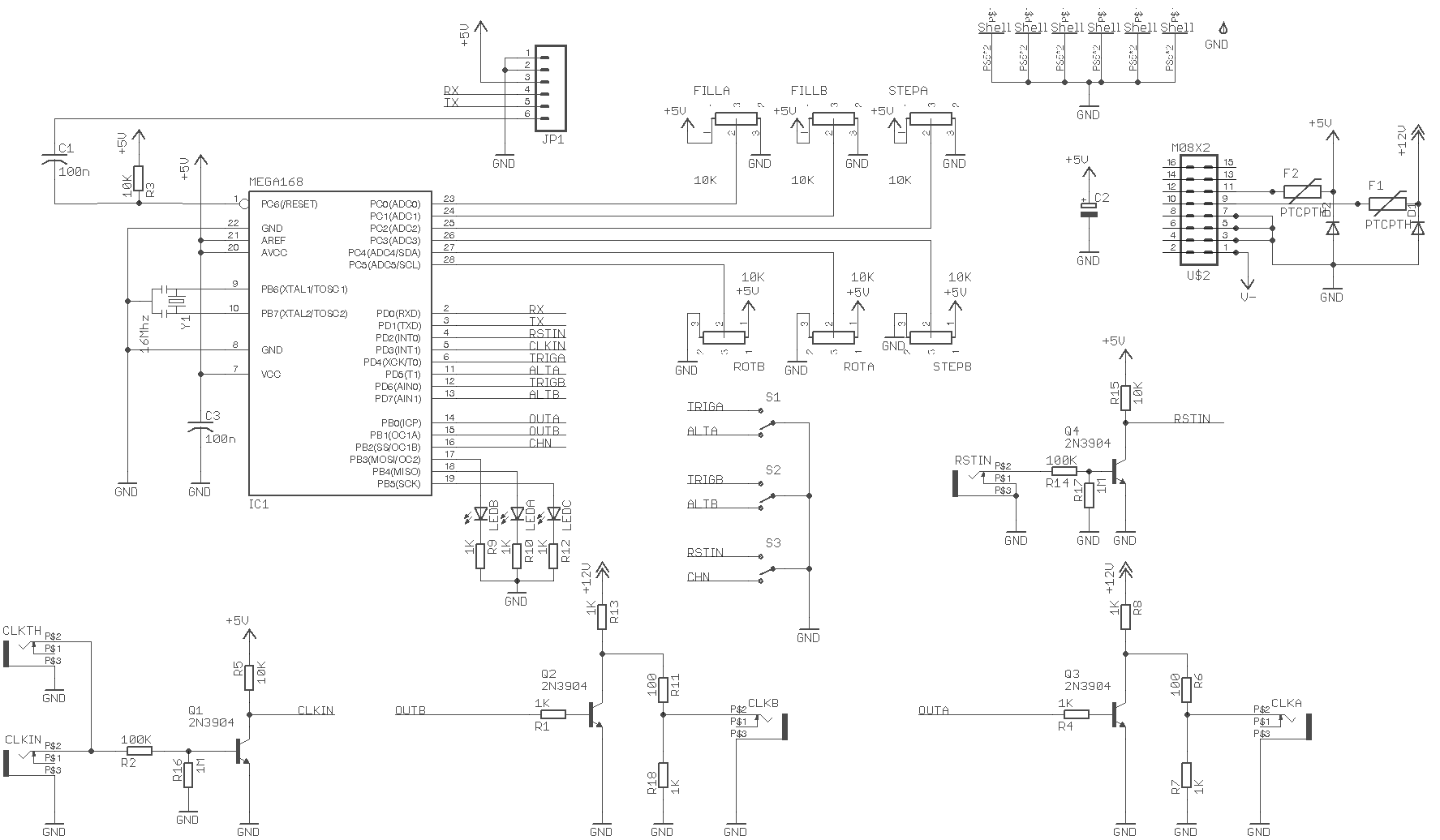
All code, schematics and documentation is licensed under the Gnu GPL.
Syntact: Moulding Sound by Miha Ciglar
Presentation on Thursday 21st of June 2012, 7pm.
Miha Ciglar is a composer and researcher in the field of audio technologies. He holds a MSc degree from the Academy of Music and the University of Technology in Graz, Austria. In 2008, Ciglar founded the Institute for Sonic Arts Research – IRZU. He is the initiator and curator of the international sonic arts festival EarZoom, which takes place annually, since 2009 in Ljubljana, Slovenia. In 2011 he founded Ultrasonic audio technologies – a start-up company, developing a wide range of products including new musical interface controllers based on non-contact tactile feedback and computer vision, directional speakers based on modulated ultrasound, as well as several mobile applications combining music making and gaming. Ciglar is the conference chair of the 2012 International Computer Music Conference (ICMC), which will be held in September 2012 at IRZU in Ljublajna, Slovenia.
Syntact – Touch the Sound

Syntact™ is a new musical interface developed at Ultrasonic audio technologies. The revolutionary technology behind it provides contact-free tactile feedback to the musician. By utilizing airborne ultrasound a force field is created in mid-air that can be sensed in a tactile way. It allows a musician to feel the actual sound with its temporal and harmonic texture. While an optical sensor system is interpreting his hand gestures and mapping the descriptors of hand motion onto sound synthesis/processing parameters, the musician can physically engage with the medium of sound by virtually moulding and shaping it – i.e. changing its acoustic appearance – directly with his hands.

Ohm Studio: the world’s first collaborative music creation tool
Ohm Studio, the first online collaborative DAW was released on Wednesday 30th of May as an open beta. It is free to join (for now), try it out here. Ohm Studio is developed by the French company Ohm Force, creators of the plug-ins Ohmicide, Frohmage and Ohmygod! This is the result of 5 years of development, and it is a very promising platform for collaborative music production. All the plug-ins of Ohm Force are freely available within the environment, with a few exclusive additions.

Jérôme Noël, Ohm Force’s CTO, gave an impromptu presentation of the software at the Music Hackspace on Thursday 31st of May. One of the impressive feature of the tool is to share music materials instantly: a friend can record a bass line in New York, while another creates beats in Berlin, and the track being produced simultaneously in London. A community of users is already helping each other out thanks to a chat room, and there is a direct support from the developers themselves.

Microtonal sequencer by Deniz N. (equal temperament can go to hell!)
On Thursday 14th of June 2012, 7pm, Deniz will present his microtonal sequencer.
Deniz kindly allowed the Music Hackspace to display his software here. The original code can be accessed on his website.
A set of instructions is available here. Apologies for the overlap onto the right column on some browsers!
London Music Hack Space welcomes Max MSP users. Desmond Dodecahedron writes…..

That's my right hand holding the Xbox controller and three people aren't even paying attention.
Last Thursday 24th May, Jean- Baptiste and Martin very kindly allowed the London Max MSP users group to be co-hosted at the Music Hack Space. Hopefully this is the start of a really good thing. We were previously guests of Lottolab at the Science Museum and if you haven’t been, you must try one of the Science Museum lates.
I decided to demonstrate a Max patch that I have been working on (and off) for about a year which is essentially an Xbox controlled device for generating new musical textures. I also wanted to widen the discussion to involve other people’s views on what they felt about controllers and instruments in general.
I began with a three chord tune played on a cheap purple and plastic ukulele purchased in Norwich. I asked if anyone could make a guess as to how long it would take the average person to learn to play Am D and E on the instrument. About three weeks was the answer, which considering the gain there seems to be quite a lot of, erm hurting fingers and frustration.
I have often wondered why considering that your smart phone has the computing power of the entire Apollo space mission, why most musical instruments haven’t progressed to the same degree as the rest of technology? We now have driverless cars, gestural recognition and Shazam. Have you ever seen a Monome on Later with Jools Holland ?
It seems quite fitting that we are about to mark 60 years of Enthronement and yet if you travelled back in time to the Marquee club or 2is coffee bar in London, you would see a drummer with a drum kit, in front of which would be a singer standing with a mic stand maybe holding a guitar. There would be bass players , keyboard players , saxophonists etc. Plus ça change – bet they said that 60 years ago too. Why don’t we have really easy to play musical instruments nowadays? The 1950s fifties housewife was rescued from the mangle by the introduction of the twintub washing machine and was consequently liberated from the laundry to try a hand at the new appliances : the hoover, cooker and the avocado slicer.

that's more like it - a waveform
I also introduced the notion of “missing music”. I remember watching Professor Jim Al-Khalili present a tv programme about Dmitri Mendeleev’s creation of the periodic table. Mendeleev noted that gaps in the grid he had constructed must denote the existence of an element that had not yet been discovered.
Not all musical instruments have been invented yet, so it must follow that not all music has been heard yet.
Which brings me to Figure 1 below.

fig 1 - diversity vs popularity
- Here is the entire spectrum of music as far as we know. Diversity here refers to harmonic and rhythmic variance. For instance the world of classical/serious music and world/ethnic music tends to exploit a wider range of time signatures, and harmonic structures than pop music does. So we have large chunks of musical void waiting to be filled.BTW I didn’t do any actual research. I mean I could have got hold of some data , but it would have taken ages and it might not have agreed with me. Sometimes you just don’t need peer review.Which is where my patch comes in. I wanted to see if it could be possible using Max to create a system where interesting and possibly complex musical patterns could be generated from very simple seeds, but at the same time there would be a degree of precision over the outcome of the process. This is another way of saying that over the years I have heard loads of random/ stochastic / generative stuff and it has not made me very haptic.I decided to use a games controller as the interface – in this case an Xbox controller because they are ubiquitous and so people feel comfortable with their familiarity -unless you are over the age of 40 which incidentally is the ball park I like to figure in.I then continued the demonstration by quickly pointing out the main features of the patch, but it’s going to take a long time to write about it now, so I am going to upload an explanatory video once I have installed Snagit and learned how to do split screen stuff which will take ages.
- There are two stages to creating musical patterns in the patch. First you create 4 (or as many as you can cope with) rhythmic figures for each of the instruments or channels you want to use – for the sake of the Hack Space demo I just used a Kore Player with 3 simple sounds loaded in to midi channels 1 to 3. Once the rhythmic patterns are created you store them as presets and they are subjected to variations in pitch groupings and subtle changes in duration and velocity whilst being triggered by the LH trigger button of the Xbox controller. In addition the LH joystick rotates the “wheel of harmony” which means that you can “seamlessly move from a minor 6th chord to a pentatonic one, all within the space of a single arpeggio” . The Dpad controls pitch changes by navigating around a “pitch grid”. Each of the presets can be cycled randomly or in groups. The RH joystick can be assigned to control whatever parameters you want in whatever Vst plug in you decide to use in Max.The consequence of this is that you can end up with results that would be very difficult to achieve with standard methods. It enables the operator to be much more playful with harmonies and rhythm. It is much more akin to playing with Plasticineexcept that you can unmix it and start afresh time after time.It is also designed to be used by more than operator if so desired i.e. one person looks after pitch and harmony, the other rhythm, and the other timbre / sounds. It is this subdivision of traditional composite musician skills in to simpler operations that lends the device to the rapid pickup and play that is missing from so many other instruments. So rather than get one boy to learn the mandolin in three weeks to play one tune, why not get three people to play ten tunes in just a couple of hours ?What if everyone played and created their own music – because they could?After the hyperbole comes the disappointment – some examples:
A result by Desmond Dodecahedron
Some more results by Desmond Dodecahedron
Afterwards I had lots of interesting chats with people over pizzas and beer. If you have a patch and want to share it then this is the place you should come to usually the last Thursday of the month.
Best Wishes
Des

Following Des came Ivaylo Chicanov who demonstrated his live sequencing patch “MaxReloop” which was designed using Max/MSP. MaxReloop uses rewire technology and sends transport messages to Propellerhead’s Reason software. These messages adjust marker and loop points allowing Ivaylo to jump around his pre sequenced performance sets and make stutter like effects. Ivaylo DJs, raps and performs using his MaxReloop software under his Electronic Element moniker.
https://www.facebook.com/ElectronicElement

The Music Tech Fest’s Hack Camp
Last week saw three days fully dedicated to assembling people with a passion for Music Tech. The Music Tech Fest, Co-organised by Ravensbourne college and tech design start-up Stromatolite, has been intense and has taken place.

And of course, there had to be a Hack Camp too. A good fifty people gathered to up on the specially-prepared sixth floor of the college to work on whatever tickled their music tech fancy. No less than 15 beautiful projects saw the day at the end of it, and were all demoed to the wider festival’s audience. The hacks were truly impressive in their range and quality. We had hardware-based, browser-based, smartphone-based, and even ping-pong-based projects.
The List of Hacks is up on the hack camp’s wiki.
The Hack Camp received pretty good media coverage too:
- Check out this article on The Next Web.
- The May 22nd BBC Outriders podcast covers the event.
- Cute pictures are here.

Max MSP London meet up
On Thursday 24th of May 2012, the Music Hackspace is hosting its first Max MSP meet up at 7pm.

Max MSP is a music programming environment that allows to bring together sensors, samples, synthesis engines and video. It is used by sound artists throughout the world, but also by visual artists and in installations. Max MSP is developed and maintained by American company Cycling’74.
If you’ve never heard of it and want to see how it works, there are a few videos to get started on the GamesSound website
We plan on hosting Max MSP meet ups once a month. Beginners are welcome.
Max MSP is popular in the electronic music scene, the image below is of a ‘patch’ (that’s how programmes made with Max are called), made and released by English band Autechre.

An Interview of Tasos Stamou, by Blanca Regina
I interviewed Tasos Stamou ( b. Athens ,1978) after the presentation of his work at the Music Hackspace, the 17th May 2012.


When did you start doing circuit bending and what was your motivation?
I started circuit bending and performing experimental music in 2006. My interests can be resumed in two basics: trying to reveal sounds from the “pandora box”, and the process of recycling and reusing the materials, that is finding new purposes for the objects again.
After circuit bending of audio, I started video bending and preparing installations of electronic and mechanical devices.
When did you come to London and why?
I came in October 2011 for two reasons: my girlfriend and to “escape” from Athens.
Where have you exhibited and shown you work?
In different galleries and venues. In 2009 I performed at the Bend Festival in New York . I have presented my installations in group exhibitions and various galleries and events. I have done sound installations, and live performances interacting with the objects.
Can you talk about your objects?
I can comment of some of the ones I used tonight.
VCO Stylophone is a circuit bended stylophone.
Field-recoder is a circuit bended soothing machine that reproduces sounds from nature.
Ark- ade is a bended toy that works as a modular sequencer.
Computerized-arcade is a bended step sequencer toy that allows to create your own melodies and manipulate them.
VHS-Synth is a videopainting tool. A circuit bended videomixer that allows you to create effects such as colorize in different ways and create noise. It also allows to create patterns such as stripes, squares and lines.
Can you talk about your practice, are you developing solo and collaborative works?
I’m a free improviser, a performer, and I develop solo and collaborative works.
In my solo works, I develop a multiphonic approach to composition, where I play with different instruments and let them interact with each other. In my video projects, I work with live video synthesis and live video painting.
In collaborative works I’m regularly improvising with Adachi Tomomi and London Improvisers Orchestra. I also improvise with other artists such as Ignaz Schick and LCDD among others. Duos that involve electroacoustic or electronic equipments but always developing free improvisation.
Thanks for your time and and joining Music Hackspace.
More about Tasos Stamou:
stamouinstruments.blogspot.com