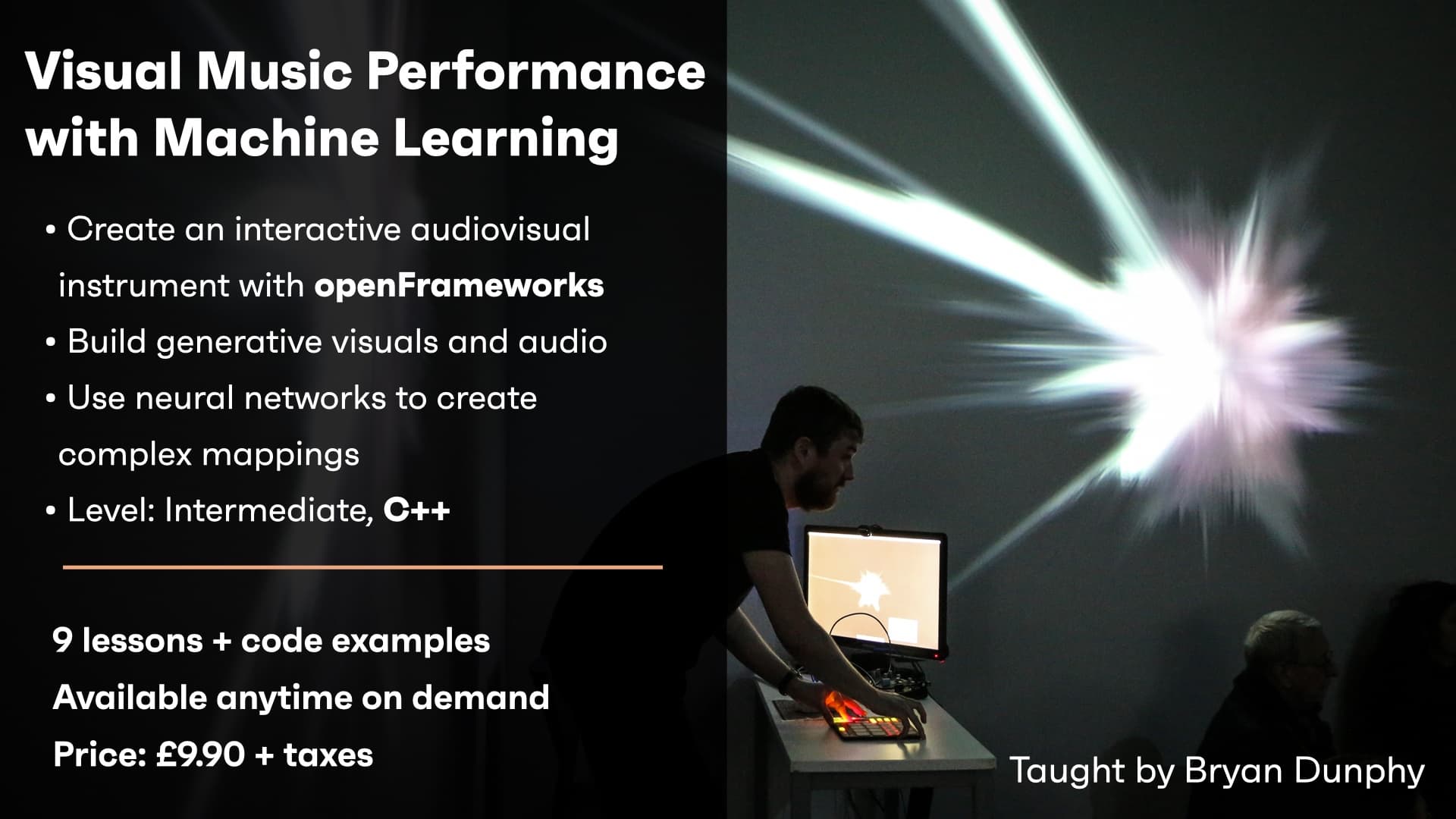
An openFrameworks build that pairs real-time graphics with audio-reactive control. The session works up a displaced sphere with Phong lighting, a camera and normal matrix, and vertex displacement, then adds sound through ofxMaxim and a simple FM synth. From there it brings in machine learning, collecting gesture data, training and running a model, and mapping it via an OSC controller so visuals and sound respond together in performance.
Creative Coding
Visual Music Performance with Machine Learning - On demand
Build an audiovisual performance system in openFrameworks, combining a Phong-lit 3D sphere with vertex displacement, an ofxMaxim FM synth, and a trained machine-learning model controlled over OSC.
Course overview
Learning outcomes
Create procedural audio in openFrameworks using ofxMaxim
Discuss interactive machine learning techniques
Use a neural network to control audiovisual parameters simultaneously in real-time
Who is this course for?
- • In this workshop you will use openFrameworks to build a real-time audiovisual instrument. You will generate dynamic abstract visuals within openFrameworks and procedural audio using the ofxMaxim addon. You will then learn how to control the audiovisual material by mapping controller input to audio and visual parameters using the ofxRapid Lib add on.
Requirements
- • A computer and internet connection
- • A web cam and mic
- • A Zoom account
- • Installed version of openFrameworks
- • Downloaded addons ofxMaxim, ofxRapidLib
- • Access to MIDI/OSC controller (optional - mouse/trackpad will also suffice)
Course content
What you will learn in this course
1 resource, 3 lessons
+
What you will learn in this course
1 resource, 3 lessons
- Course Overview
- Requirements
- Pre-course preparation
- Work sheet with exercises
Visual Music Performance with Machine Learning - On demand
9 videos, 2 lessons
+
Visual Music Performance with Machine Learning - On demand
9 videos, 2 lessons
Part 1 - Sphere setup
Checking access...Part 2 - Phong lighting
Checking access...Part 3 - Camera + Normal matrix
Checking access...Part 4 - Vertex displacement
Checking access...Part 5 - ofxMaxim setup
Checking access...Part 6 - Simple FM synth
Checking access...Part 7 - Machine Learning - Data collection
Checking access...Part 8 - Machine Learning - Train + Run model
Checking access...Part 9 - OSC controller
Checking access...- Finished Project on Github
- Was this course the right level?
Instructors
Bryan Dunphy
Bryan Dunphy graduated in 2021 from a PhD at Goldsmiths University. He specialises in audio-visual, immersive performances and creations. Most of his work uses Machine Learning.