Creative Coding
Neural Networks via FluCoMa In Max
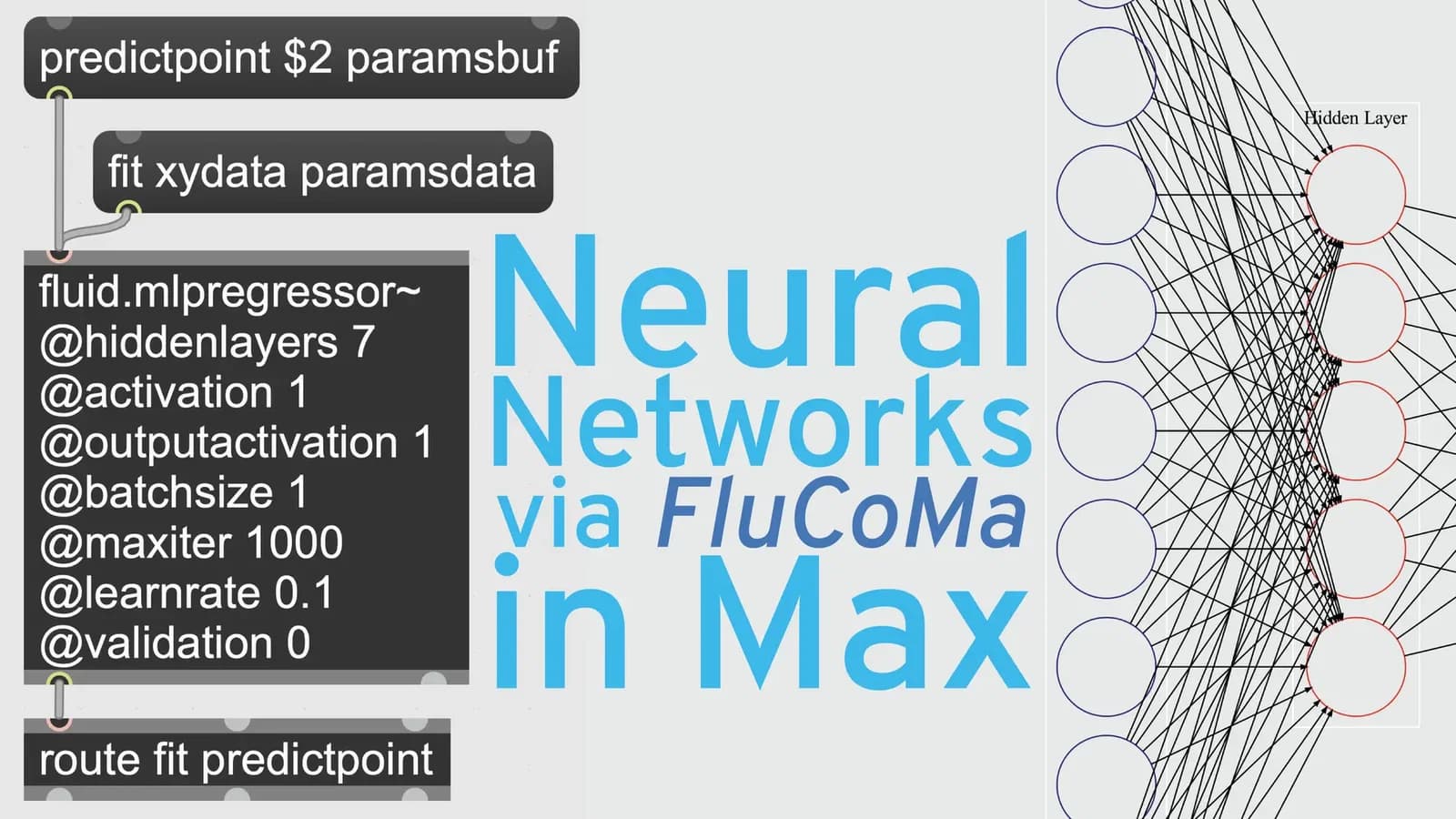
Build and train neural networks inside Max using FluCoMa, working with fluid.mlpclassifier and fluid.mlpregressor for audio classification, regression with audio descriptors, and a wavetable autoencoder, plus tuning hidden layers, learn rate and overfitting.
Course overview
Using Machine Learning for composition and sound design
The Fluid Corpus Manipulation project (FluCoMa) provides novel machine learning tools for use in the digital composition process. The MLPRegressor is a neural network that can be used to perform regression.
What is Regression?
In Machine Learning, regression can be thought of as a mapping from one space to another where each space can be any number of dimensions. By providing input and output data as DataSets, the neural network is trained using supervised learning to predict output data points based on input data points. This gives a vast array of creative possibilities for composition, sound design and performance.
What to expect in this workshop?
In this workshop, Ted Moore from the FluCoMa project guides you through an exploration of some of the creative possibilities available via Neural Networks with their Max Package. Basic experience of FluCoMa is advised before joining this workshop course. For example, it is recommended that you have taken the free on-demand workshop Using Machine Learning Creatively via FluCoMa In Max.
Learning outcomes
Use training and testing data to validate trained models
Troubleshoot the training process by adjusting neural network parameters
Combine different types of input and output data
Requirements
- • A computer and internet connection
- • Access to a copy of Max 8 (i.e. trial or full license)
- • Install of the free FluCoMa Max package
Course content
Course Videos
32 videos, 1 resource, 1 lesson
+
Course Videos
32 videos, 1 resource, 1 lesson
- Presentation slides (63 pages)
- Flucoma patches
1. Introduction _ What is FluCoMa_
Checking access...2. Plan _ Outline
Checking access...3. Classification
Checking access...4. Multilayer-Perceptron
Checking access...5. A Musical Motivation for Classification
Checking access...6. Supervised vs. Unsupervised Learning
Checking access...7. Training a Classifier
Checking access...8. Feed-forward and Back-propagation
Checking access...9. Classification Patch
Checking access...10. The _error_ _Training fluid.mlpclassifier~
Checking access...11. Making Predictions with fluid.mlpclassifier
Checking access...12. Validation with Training & Testing Data
Checking access...13. Saving a Trained Neural Network for Later Use
Checking access...14. Doing Classification with fluid.mlpregressor~
Checking access...15. Artistic Use of Classification
Checking access...17. Automated Dataset Creation and Validation
Checking access...18. Neural Network Parameters (Object Attributes)
Checking access...19. Hiddenlayers
Checking access...20. Activation and Outputactivation
Checking access...21. Learnrate
Checking access...22. Maxiter
Checking access...23. Batchsize
Checking access...24. Validation
Checking access...25. Overfitting
Checking access...26. Momentum
Checking access...27. Q&A on Parameters
Checking access...28. Neural Network Regression with Audio Descriptors
Checking access...29. Musical Example
Checking access...30. Training fluid.mlpregressor~
Checking access...31. Wavetable Autoencoder
Checking access...32. @tapin and @tapout
Checking access...33. Final Q&A
Checking access...
Instructors

Ted Moore
Ted Moore (he / him) is a composer, improviser, and intermedia artist. He holds a PhD in Music Composition from the University of Chicago and recently served as a Research Fellow in Creative Coding at the University of Huddersfield, investigating the creative affordances of machine learning and data science algorithms as part of the FluCoMa project. His work focuses on fusing the sonic, visual, physical, and acoustic aspects of performance and sound, often through the integration of technology.