Creative Coding
Getting started with Interactive Machine Learning for openFrameworks / Workshop series - On-demand
Using openFrameworks, ofxRapidLib and ofxMaximilian, participants will learn how to integrate machine learning into generative applications. You will learn about the interactive machine learning workflow and how to implement classification,
Course overview
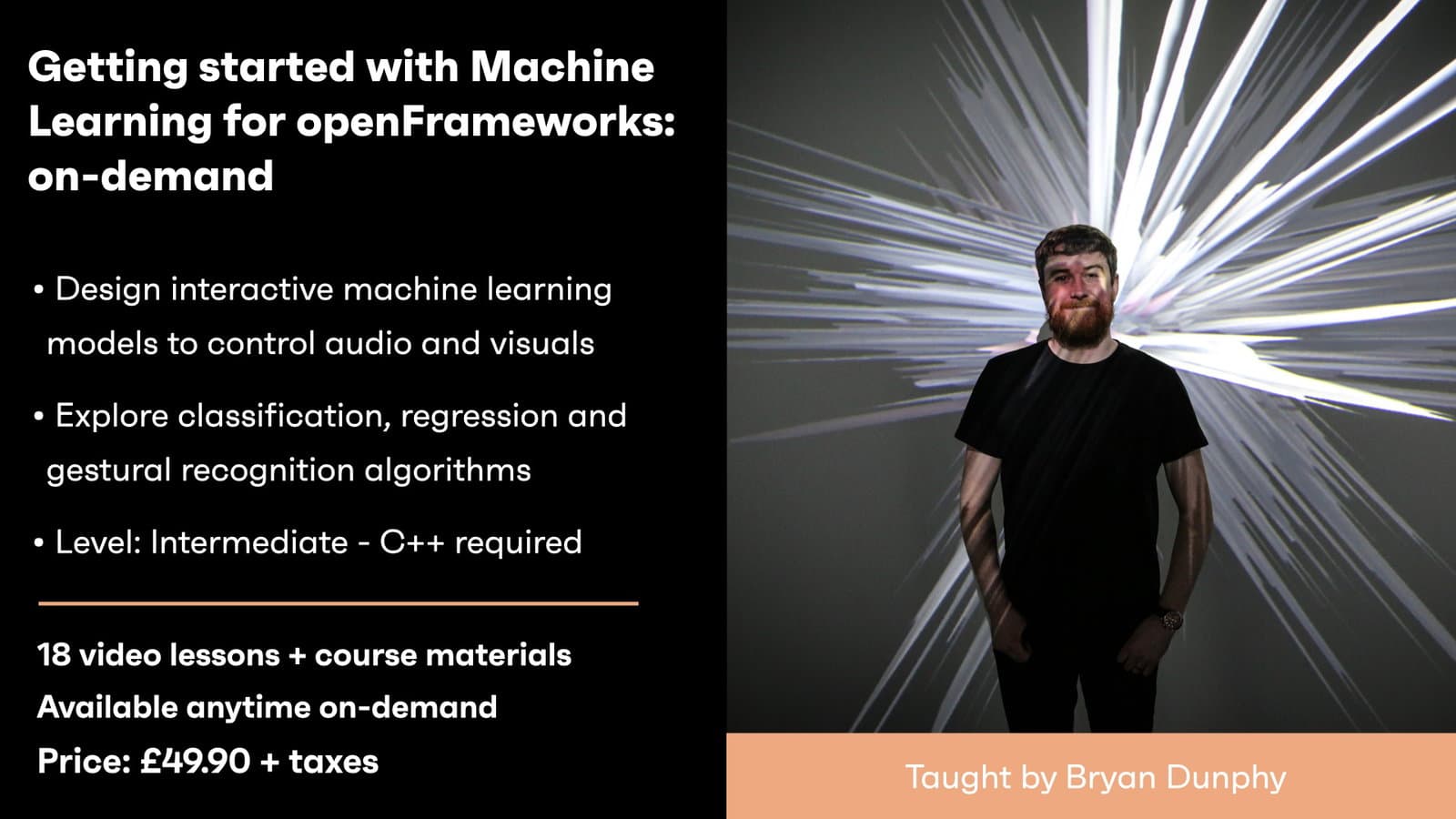
Using openFrameworks, ofxRapidLib and ofxMaximilian, participants will learn how to integrate machine learning into generative applications. You will learn about the interactive machine learning workflow and how to implement classification, regression and gestural recognition algorithms.
Learning outcomes
Session 2: Set up an openFrameworks project for regression, Collect data and train a neural network, Use the neural network output to control audio parameters and Adjust inputs to refine the output behaviour
Session 3: Set up an openFrameworks project for series classification, Design gestures as control data, Use classification of gestures to control audio output and Refine gestural input to attain desired output
Session 4: Explore methods for increasing complexity, Integrate visuals for multimodal output, Build mapping layers and Use models in parallel and series
Who is this course for?
- • You will explore a static classification approach that employs the k-Nearest Neighbour (KNN) algorithm to categorise data into discrete classes. This will be followed by an exploration of static regression problems that will use multilayer perceptron neural networks to perform feed-forward, non-linear regression on a continuous data source. You will also explore an approach to temporal classification using dynamic time warping which allows you to analyse and process gestural input.
Requirements
- • A computer and internet connection
- • Installed versions of the following software: openFrameworks, ofxRapidLib and ofxMaxim
- • Preferred IDE (eg. XCode / Visual Studio)
Course content
Course Overview
1 resource, 2 lessons
+
Course Overview
1 resource, 2 lessons
- What you will learn in this course
- Requirements
- Links to Reading Material and Code Tutorials Related to the Course
Getting started with Interactive Machine Learning for openFrameworks - On-demand / Session 1
3 videos, 1 resource
+
Getting started with Interactive Machine Learning for openFrameworks - On-demand / Session 1
3 videos, 1 resource
- Code for Week 1
Part 1 - IML Terminology
Checking access...Part 2 - Collect and Label Data
Checking access...Part 3 - KNN Classification
Checking access...
Getting started with Interactive Machine Learning for openFrameworks - Session 2 / On-demand
4 videos, 1 resource
+
Getting started with Interactive Machine Learning for openFrameworks - Session 2 / On-demand
4 videos, 1 resource
- Code Templates for Week 2
Part 1 - Static Regression
Checking access...Part 2 - Project Setup
Checking access...Part 3 - Training The Network
Checking access...Part 4 - Controlling Audio
Checking access...
Getting started with Interactive Machine Learning for openFrameworks - Session 3 / On-demand
6 videos, 1 resource
+
Getting started with Interactive Machine Learning for openFrameworks - Session 3 / On-demand
6 videos, 1 resource
- Code for Week 3
Part 1 - Dynamic Time Warping
Checking access...Part 2 - Project Setup
Checking access...Part 3 - Collect Data
Checking access...Part 4 - Train and Run Model
Checking access...Part 5 - FM Synth Control
Checking access...Part 6 - Triggering Processes
Checking access...
Getting started with Interactive Machine Learning for openFrameworks - Session 4 / On-demand
5 videos, 1 resource
+
Getting started with Interactive Machine Learning for openFrameworks - Session 4 / On-demand
5 videos, 1 resource
- Week 4 Code
Part 1 - Parallel Models Setup
Checking access...Part 2 - Controlling Parallel Models
Checking access...Part 3 - Gestural Selector
Checking access...Part 4 - Multi-modal Output
Checking access...Part 5 - Models in Series
Checking access...
Instructors

Bryan Dunphy
Bryan Dunphy graduated in 2021 from a PhD at Goldsmiths University. He specialises in audio-visual, immersive performances and creations. Most of his work uses Machine Learning.